

When a washer becomes the constraint, it rarely announces itself as a single failure. Operators slow infeed to compensate for residue, graders reject more product, downstream belts run wetter than planned and sanitation crews inherit solids that should have been controlled earlier. A commercial fruit and vegetable washing machine protects throughput only when it removes soil and organic load without creating new limits in water demand, rework, belt carryback or cleaning downtime.
For plant managers and hygiene teams, the washer is not a standalone hygiene asset. It is a production control point that influences sorting accuracy, packing rhythm, water balance, labor allocation and the amount of wet housekeeping required around the line. The right specification depends on the commodity, incoming soil load, line speed, transfer design, utility capacity and the tolerance of downstream equipment.
What a commercial fruit and vegetable washing machine must protect
Throughput protection starts with defining what the washer must prevent, not only what it must remove. In a fruit or vegetable line, poor washing performance can reduce capacity in several ways: visible residue triggers rework, excess water carryover affects sorting and packing, solids migrate to conveyors and drains, and operators add manual hose work to keep the line stable.
A washer that looks adequate during a short trial can still underperform during peak load if it has limited solids removal, uneven spray coverage or insufficient drainage. This is why hygiene and production teams should evaluate washing performance under the dirtiest realistic product conditions, not only under average incoming quality.
The best equipment decisions are usually made when production, hygiene, maintenance and utilities are involved early. A technically sound washer that overloads drains or requires frequent manual cleaning may protect product quality but still damage line availability.
Throughput losses start before the wash zone
Many washing bottlenecks are created upstream. Field soil, leaves, stems, peel fragments and damaged product enter the line unevenly, so the washer receives a variable load rather than a predictable one. If the feed is inconsistent, even a well-built commercial fruit and vegetable washing machine may be forced into stop-start operation because the line must slow down to regain cleaning stability.
Receiving, pre-sorting and dry removal steps deserve attention because they reduce the amount of contamination that reaches the washer. Solids that can be removed before water contact are usually cheaper to manage than solids suspended in wash water, trapped in filters or spread across wet conveyors.
IWC has written in more detail about where fruit and vegetable processing loses water and time, including receiving, flumes, spray zones, conveyors and sanitation. That line-wide view matters because washer performance is often judged too narrowly. If the washer improves cleaning but pushes excess water and debris downstream, the bottleneck simply moves.
Spray precision matters more than pump size
Adding pressure or water volume is often the first reaction when washing performance is inconsistent. In practice, more water does not automatically create better cleaning. It can increase splash, overspray, drain load, water heating demand and wet floor conditions while still missing shielded areas on the product or equipment.
A commercial fruit and vegetable washing machine should apply cleaning energy where it is needed. Nozzle position, droplet behavior, spray angle, product rotation, residence time and distance to the product surface all affect the result. For delicate produce, the goal is controlled impact rather than aggressive force. For heavier soil loads, the system needs enough mechanical action to dislodge contamination without damaging product or overwhelming wastewater handling.
This is where engineered water use becomes important. IWC’s Undine® technology uses water mixed with compressed air under pressure to create high-velocity microdroplets. The practical value is not simply that less water is used, but that the cleaning effect can be directed more efficiently at the surface or equipment area that needs attention.
Protecting belts, rollers and transfer points
Washers often get blamed for throughput problems that actually happen at transfers, belts, rollers, elevators and discharge points. Product leaves the washer carrying water and loosened residue. If the next belt has poor drainage, inaccessible return runs or residue traps near guides and sidewalls, the line can accumulate contamination faster than sanitation teams can manage it.
For this reason, the washer should be specified together with the immediate downstream layout. A commercial fruit and vegetable washing machine that delivers clean product into a poorly controlled transfer zone will still leave the plant with hygiene pressure, manual intervention and avoidable downtime.
Conveyors are especially important because they can spread moisture and organic material across large areas of the line. Targeted belt cleaning, controlled spray containment and access for inspection help prevent small residues from becoming line-wide housekeeping work. IWC’s article on what makes a water cleaning method effective on conveyors is relevant here because conveyor cleaning performance depends on contact, coverage and controlled water use, not only pressure.
How washer design affects labor and changeover
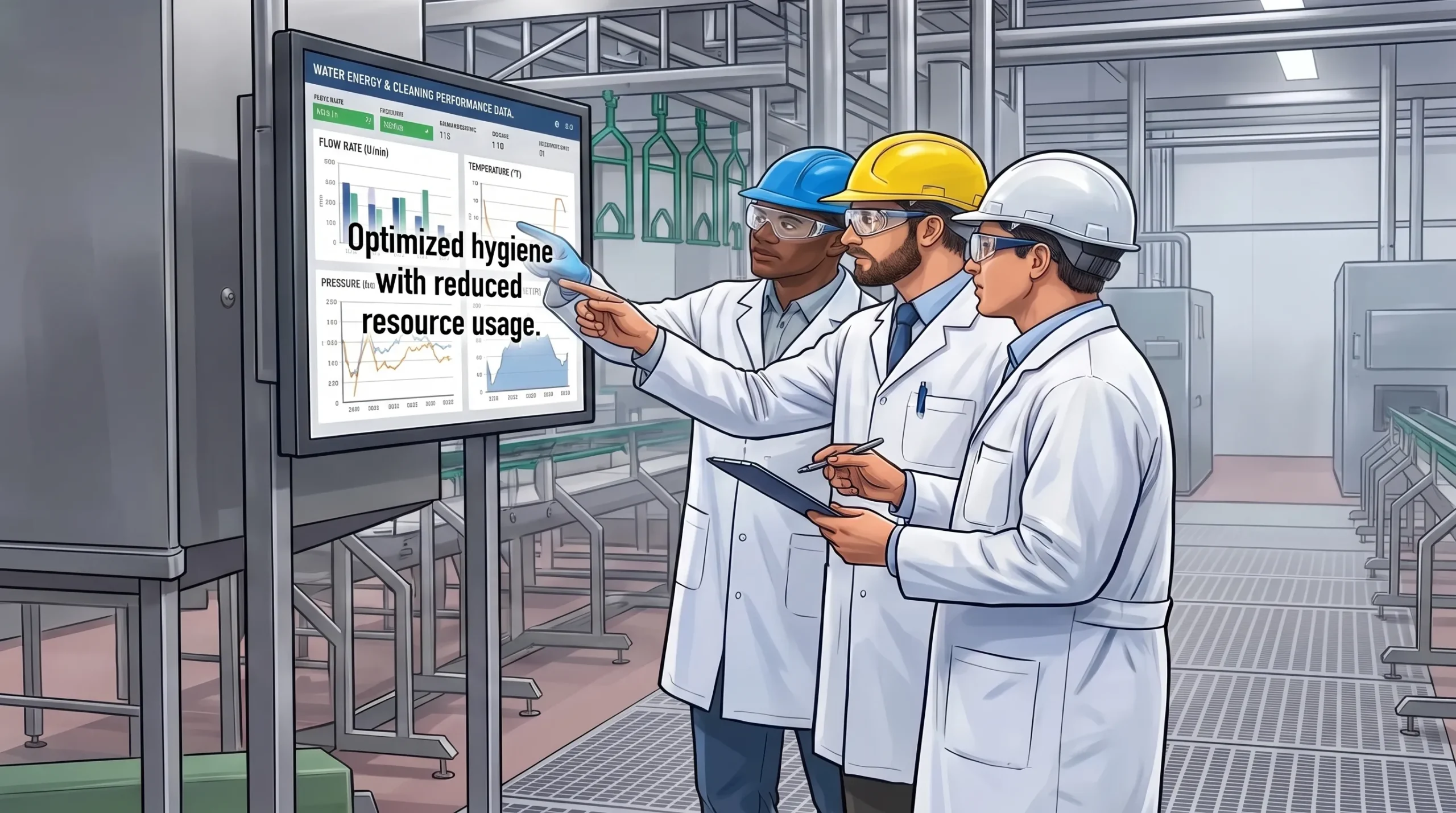
Labor pressure in produce processing is not only about headcount. It is also about how much skilled time is diverted to manual rinsing, drain clearing, filter cleaning, re-cleaning after inspection and changeover work between products or batches. When these tasks become routine, the washer is consuming labor indirectly.
The right commercial fruit and vegetable washing machine reduces repeat manual intervention by controlling solids earlier, keeping spray zones stable and avoiding excessive wet carryover. For hygiene managers, this improves consistency. For operations managers, it protects available production minutes. For maintenance teams, it reduces the number of emergency adjustments caused by blocked nozzles, overloaded filters or residue buildup around moving parts.
Changeover should be reviewed with the same discipline as in-line production. Access panels, nozzle inspection, belt lift points, drainage slope and cleanability around guards can determine whether a changeover is predictable or repeatedly extended. A washer that cleans well during production but takes too long to reset can still reduce daily output.
| Throughput factor | Common failure mode | What to verify before investment |
|---|---|---|
| Incoming soil load | Washer overwhelmed during peak harvest or wet field conditions | Test against worst-case product condition and actual line speed |
| Water application | High volume used without targeted cleaning effect | Check nozzle layout, droplet impact, spray containment and coverage |
| Solids control | Filters, drains or screens require frequent manual attention | Review solids removal, access and cleaning frequency |
| Carryover | Downstream belts and packing zones become wet or dirty | Confirm drainage, product discharge and transfer design |
| Changeover | Cleaning or inspection takes longer than planned | Assess access, tool requirements and repeatability |
| Utilities | Pump, air, drainage or wastewater capacity limits the line | Validate available utilities under full production load |
Integration questions before buying or upgrading
A washer purchase should not begin with tank size or pump capacity alone. It should begin with line integration. The available footprint, floor slope, drain location, compressed air capacity, electrical layout, operator access and maintenance clearance all influence whether the installation protects production continuity.
A commercial fruit and vegetable washing machine also needs to match downstream commercial expectations. Processors supplying fresh-cut operations, retail packers, foodservice kitchens or online grocery marketplaces in the UAE such as Sandhai are often judged on visual quality, consistency and shelf presentation as much as line efficiency. Washing variability can therefore become a customer-facing issue, not only a factory problem.
Before approving an upgrade, teams should define the operational target in measurable terms. That may be fewer manual cleaning minutes per shift, lower water consumption per tonne, reduced rework at inspection, more stable line speed or fewer sanitation delays at the end of production. The target determines the equipment setup.
Where Undine® fits into produce washer strategy
IWC’s role is not to treat every produce line as if it needs the same washer. The company focuses on industrial cleaning and contamination-control solutions that can be adapted to the process step, equipment design and hygiene challenge. For fruit and vegetable applications, IWC describes its air-water microdroplet approach for fruits and vegetables as a way to improve cleaning efficiency while reducing water, energy and labor demand.
In practical terms, Undine® can be relevant where a commercial fruit and vegetable washing machine needs more controlled cleaning impact without simply increasing water volume. It can also be considered around conveyors, crates, filters or other equipment where residue buildup creates labor, hygiene or uptime issues.
Savings should always be assessed against the current process. Depending on the application, current situation and production environment, IWC indicates that savings of up to 70% on water and energy consumption and up to 60% on labor costs may be possible. Those figures are not a blanket guarantee. They are a reason to evaluate the cleaning process with real line data and a clear baseline.
ROI should be measured at the line, not only at the washer
The financial case for a washer upgrade is often weakened when teams only compare equipment price. A more accurate view includes the cost of water, energy, wastewater handling, manual cleaning, production interruptions, product rework, maintenance and the opportunity cost of slower line speed.
A commercial fruit and vegetable washing machine protects throughput when it reduces the hidden losses that surround the wash zone. These losses include operators slowing the line to maintain quality, sanitation teams extending cleanup because residue escaped the washer, maintenance staff responding to blocked components and production planners losing capacity during changeovers.
This is why a useful ROI review should use plant data rather than assumptions. Measure water use per shift, cleaning time per product type, drain or filter intervention frequency, inspection rework and washer-related downtime. If the baseline is clear, the impact of a better washing method can be evaluated more credibly across hygiene, operations and sustainability.
For plants already trying to reduce waste, IWC’s article on how fruit and vegetable processing companies cut washdown waste adds a useful companion perspective. Washdown control and washer performance are closely connected because both depend on targeted water use, solids management and practical line design.
Practical specification checklist
Before selecting or modifying a produce washer, align the project team on the conditions the system must handle. The most useful discussions are specific: product type, peak soil load, line speed, cleaning frequency, residue behavior, available utilities, required access and acceptable downtime.
The following questions help separate a washer that only performs in theory from one that protects throughput in daily production:
- What is the dirtiest realistic incoming product condition, and has the washer been evaluated against it?
- Where do solids, peel, leaves or soil currently accumulate during production?
- How much manual rinsing is needed to keep the line running at target speed?
- Are drains, filters and wastewater systems sized for the proposed cleaning method?
- Can nozzles, belts, screens and guards be inspected without excessive downtime?
- Does the washer reduce downstream carryover or simply move the problem to the next conveyor?
- Which metric will prove success: water use, labor minutes, rework, downtime, line speed or a combination?
The strongest specifications are built around the production constraint. If the current limit is manual sanitation, the solution should reduce labor exposure. If the limit is wastewater capacity, the solution should control water volume and solids. If the limit is inspection rework, the focus should be cleaning consistency at production speed.
FAQ's about commercial produce washers and line throughput:
How does a produce washer affect line throughput? It affects throughput through cleaning consistency, water carryover, solids control, rework at inspection, manual intervention and changeover time. If any of these factors are unstable, the line may need to slow down even when the washer itself is mechanically running.
Is higher water pressure always better for washing fruit and vegetables? No. Higher pressure can increase splash, product damage risk, energy use and wastewater load. Effective washing depends on targeted impact, coverage, residence time, product handling and drainage as well as pressure.
When should a plant consider upgrading its washer? A plant should review its washer when cleaning performance limits line speed, operators rely on frequent manual hose work, downstream belts carry excess residue or water use and wastewater load are rising without better hygiene results.
Can a commercial fruit and vegetable washing machine reduce labor costs? It can reduce labor demand when it automates repeatable cleaning tasks, controls solids more effectively and reduces re-cleaning or manual washdown. The actual saving depends on the application, existing process and line layout.
How should ROI be calculated for a washer upgrade? ROI should include equipment cost, water, energy, wastewater handling, labor, maintenance, downtime, rework and production capacity. A plant-level baseline is needed before any improvement can be measured credibly.
If your wash zone is protecting product quality but costing too much in water, labor or lost uptime, the next step is to evaluate it as part of the complete line. IWC International can help assess where cleaning energy, microdroplet technology and custom integration may improve hygiene performance while supporting throughput and resource efficiency.