
Water is not just a utility in food production. It is part of hygiene control, product quality, employee safety, equipment performance, and daily production continuity. That is why the best solutions to save water on food production lines do not simply reduce flow rates everywhere. They apply water more accurately, remove waste earlier, improve mechanical impact, and make cleaning results more repeatable.
For plant managers, hygiene managers, technical teams, and sustainability leaders, the challenge is to lower water consumption without increasing contamination risk or extending sanitation time. In poultry processing, meat production, fruit and vegetable handling, and other food manufacturing environments, this requires a practical balance between cleaning performance, water use, energy use, labor, and downtime.
The following approach focuses on operational changes and technology choices that can be assessed inside an existing production environment.
What saving water should mean in a food production environment
In industrial food production, saving water should never mean under-cleaning. It should mean using the right amount of water at the right point, with the right impact, for the right duration.
Traditional cleaning often relies on high volumes of water to compensate for poor targeting, difficult access, inconsistent manual work, or continuous spraying where intermittent cleaning would be enough. This can increase water bills, wastewater load, heating demand, chemical consumption, and labor time. It can also create more splashing and moisture in areas where contamination control depends on separation and control.
A strong water-saving program should therefore be built around three questions:
- Where is water essential for hygiene or product safety?
- Where is water being used because the current cleaning method is inefficient?
- Where can better targeting, automation, or inline cleaning reduce waste without lowering cleaning quality?
This is especially important in poultry processing, where belts, shackles, crates, filters, modules, and other production equipment can carry organic material through multiple process steps. Water reduction should be connected to better soil removal, lower recontamination risk, and more predictable cleaning outcomes.
Start with a water-use map, not a general reduction target
Before selecting equipment or changing cleaning procedures, production teams need a clear view of where water is used. A site-wide reduction target is useful for sustainability reporting, but it is not specific enough for line-level improvement.
A practical water-use map identifies each relevant water point on the production line and connects it to its function. This includes product rinsing, belt cleaning, crate washing, shackle cleaning, filter cleaning, floor washdown, equipment rinsing, and any continuous spray points. If your team has not yet measured line-level consumption, a structured water-use baseline for food processing lines is usually the best first step.
The goal is not only to know total cubic meters per day. The goal is to understand which water use creates hygiene value and which water use is mainly caused by poor control.
| What to measure | Why it matters for water savings |
|---|---|
| Flow rate per water point | Shows where the largest direct consumption occurs |
| Operating time per shift | Reveals continuous sprays and long-running cleaning points |
| Water temperature | Connects water savings to energy savings where hot water is used |
| Water pressure and spray pattern | Helps identify inefficient impact or overspray |
| Soil load and type | Determines whether mechanical action, dwell time, or pre-removal must improve |
| Manual cleaning time | Shows where water use is linked to labor cost and inconsistency |
| Recleaning frequency | Identifies areas where poor first-pass cleaning wastes water and time |
Where water-saving improvements often have the highest value
| Production area or equipment | Typical water-saving opportunity | Operational value |
|---|---|---|
| Conveyor belts | More targeted inline cleaning and reduced overspray | Less buildup, more consistent hygiene, lower manual cleaning effort |
| Crates and modules | Better spray targeting and controlled wash cycles | Reduced water waste during repetitive washing operations |
| Shackles | Focused cleaning at contact points and difficult geometries | Improved cleaning consistency in a critical poultry process area |
| Filters and screens | Cleaning methods that reduce clogging and manual intervention | Less downtime and lower cleaning labor |
| Floor and drain areas | Dry removal before washdown and controlled water use | Lower water volume and reduced spread of residues |
| Product transfer points | Targeted cleaning where soil accumulates | Reduced contamination transfer and less recleaning |
The practical rule is to focus first on areas where water savings, hygiene improvement, labor reduction, and production continuity overlap.
How microdroplet cleaning can support lower water use

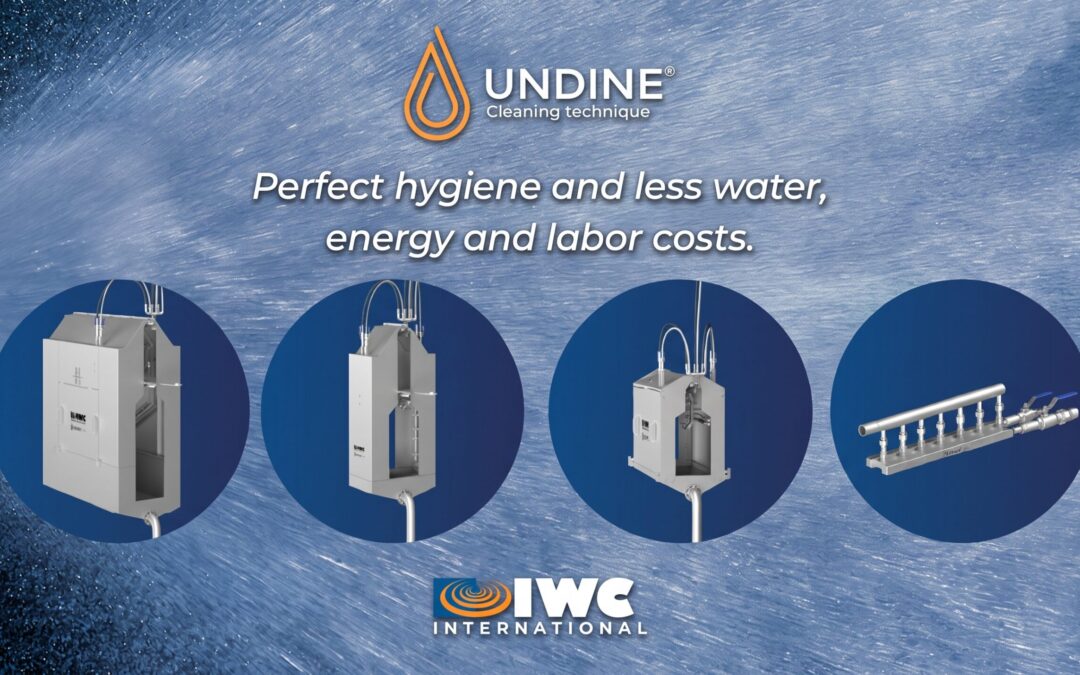
IWC International’s Undine® technology is designed for industrial cleaning and contamination-control applications in food production environments. The technology mixes water and compressed air under pressure to create high-velocity microdroplets. In practical terms, this means cleaning performance is supported by droplet impact and targeted application rather than relying only on high water volume.
For food plants, the value is not simply that less water may be used. The value is that water can be applied more efficiently to the surface or contamination point that needs cleaning. This can help improve the balance between hygiene performance, water consumption, energy demand, and labor input.
Depending on the application, current cleaning method, production environment, and technical setup, Undine® technology can save up to 70% on water and energy consumption and up to 60% on labor costs. These results are application-specific and should be assessed against the plant’s existing process, cleaning requirements, and operational goals.
Undine® can be relevant for cleaning conveyor belts, crates, shackles, filters, and other processing equipment where conventional cleaning uses excessive water or requires significant manual intervention. It can also be considered where inline cleaning would reduce unnecessary disassembly or help manage contamination load during production.
Building the business case for water-saving cleaning technology
Water savings alone may not justify a project if they are viewed only as a utility reduction. The business case becomes stronger when the full operational impact is included.
A practical business case should compare the current process with the proposed improvement across several metrics.
| KPI | Why it should be included |
|---|---|
| Cubic meters of water per shift or per production volume | Shows direct water reduction potential |
| Hot water or energy use | Captures savings linked to heating, pumping, and pressure |
| Labor hours for cleaning | Shows the operational cost of manual cleaning work |
| Cleaning-related downtime | Connects sanitation efficiency to available production time |
| Recleaning or corrective cleaning events | Measures consistency and first-pass cleaning performance |
| Wastewater volume and load | Shows downstream impact on treatment and discharge |
| Hygiene verification results | Confirms that water reduction does not compromise cleaning objectives |
For operations directors and plant managers, this creates a more complete view of return on investment. For hygiene and food safety teams, it keeps the focus on cleaning effectiveness. For sustainability teams, it provides measurable progress without treating water reduction as a stand-alone target.
Improve water efficiency without weakening cleaning performance
Saving water on food production lines is most effective when it is treated as an operational improvement project, not only a sustainability target. By mapping water use, targeting cleaning impact, reducing continuous spraying, improving inline cleaning, and measuring energy and labor together, plants can work toward cleaner and more efficient production.
IWC International supports food producers with industrial cleaning technology, process expertise, and custom solutions for demanding production environments. If you want to evaluate where water, energy, labor, and hygiene performance can be improved in your process, contact IWC International to discuss the right approach for your production line.
Practical solutions to save water on food production lines
Remove dry material before wet cleaning
One of the simplest ways to reduce water use is to remove as much loose material as possible before wet cleaning begins. In many food production environments, water is used to move product residue that could first be scraped, brushed, vacuumed, or collected mechanically.
Dry removal is not suitable for every area, especially where hygiene zoning or aerosol control is critical, but it can reduce the amount of water needed during the first cleaning stage. It also helps prevent organic load from spreading across floors, drains, belts, or surrounding equipment.
In poultry plants, this principle can apply to areas where feathers, fat, tissue, or other residues accumulate before final cleaning. By reducing the initial soil load, the wet cleaning system can focus on targeted removal rather than bulk transport.
Target the point of impact instead of increasing water volume
When cleaning performance is poor, the first response is often to increase pressure, flow, or cleaning time. That can help in some cases, but it can also waste water if the spray does not hit the right surface with the right pattern.
Nozzle position, spray angle, distance to the surface, belt speed, droplet behavior, and the geometry of the equipment all affect cleaning impact. A small adjustment in where water hits the contamination can sometimes reduce the need for long rinsing cycles.
This is particularly relevant for conveyor belts, shackles, rollers, guides, and hard-to-reach equipment surfaces. If water misses the contamination point, the plant pays for water, energy, and wastewater treatment without receiving the full hygiene benefit.
Replace continuous spraying with controlled activation
Continuous water flow is common in production environments because it is simple and familiar. However, it often creates unnecessary consumption during gaps in product flow, shift changes, pauses, or moments when contamination load is lower.
Controlled activation can reduce this waste. Depending on the process, water can be activated by line movement, product presence, timed cycles, pressure control, or sanitation requirements. The right setup depends on the equipment and hygiene objective, but the principle is the same: water should be available when it adds value and reduced when it does not.
This approach is useful for inline belt cleaning, crate cleaning, shackle cleaning, and other repetitive cleaning points. It also helps teams control variability between shifts because the cleaning action depends less on individual operator habits.
Use inline cleaning for areas that soil continuously
Some production line areas do not only need end-of-shift cleaning. They accumulate contamination during production. If these areas are only cleaned manually after production, the plant may face higher soil buildup, longer cleaning windows, and more intensive water use.
Inline cleaning can help control contamination load during operation or between production phases, depending on the process and hygiene requirements. The aim is not to replace the full sanitation program where it remains necessary. The aim is to reduce buildup, improve consistency, and lower the effort required during later cleaning.
In poultry processing, inline cleaning can be especially relevant for conveyor belts, shackles, filters, and other surfaces that repeatedly contact product or by-product streams. For more poultry-specific considerations, IWC has also covered how to cut water use in poultry processing without losing hygiene.
Improve repeatability to reduce recleaning
Water savings are often lost when cleaning has to be repeated. Recleaning consumes additional water, extends downtime, increases labor demand, and can create pressure on production schedules.
Repeatability is therefore a water-saving issue. Automated or semi-automated cleaning systems can help standardize spray position, duration, impact, and coverage. This does not remove the need for hygiene verification, but it reduces reliance on manual variation.
For hygiene managers, repeatability supports more predictable cleaning outcomes. For plant managers, it helps reduce unexpected delays. For maintenance teams, it can also make the cleaning process easier to inspect and adjust.
Consider wastewater and energy, not water alone
Every liter of water used in a food plant has consequences beyond the water meter. It may need to be pumped, heated, treated, pressurized, chemically managed, and discharged. Reducing unnecessary water use can therefore support lower energy use, lower wastewater volume, and lower operational cost.
This is why water-saving decisions should be evaluated together with energy and labor. A system that reduces water but increases manual work may not deliver the best operational result. A system that reduces water and hot water demand may create value in both utility consumption and sanitation efficiency. The water and energy performance of cleaning processes should be reviewed as one connected system.
Integration factors to review before changing the cleaning process
A water-saving solution must fit the production reality. Even a technically strong system will not deliver value if it creates avoidable downtime, maintenance complexity, or hygiene uncertainty.
Before implementation, plant and technical teams should review:
- The exact equipment or process step to be cleaned
- Soil type, contamination load, and hygiene objective
- Available water pressure, compressed air, drainage, and utilities
- Line speed, production schedule, and cleaning window
- Access for inspection, maintenance, and adjustment
- Required validation, monitoring, and hygiene verification
- Impact on labor, downtime, energy, and wastewater handling
This is where standard solutions and custom solutions may differ. Some cleaning challenges can be solved with a proven configuration. Others require adaptation to the line layout, product flow, hygiene zoning, or equipment geometry.
For decision-makers, the question should not be “Can we use less water?” The better question is “Which cleaning setup gives us the required hygiene result with the lowest practical water, energy, labor, and downtime burden?”
A practical implementation sequence
Food plants do not need to change every cleaning point at once. In many cases, a phased approach is more practical and easier to validate.
Start with one high-impact area where the current process is water-intensive, labor-intensive, or inconsistent. Measure the current baseline, define the hygiene and operational targets, test the improved cleaning method, and compare results. If the outcome is positive, the same method can be adapted to similar areas elsewhere in the plant.
This approach reduces implementation risk. It also gives internal stakeholders clearer evidence before expanding the project across multiple lines or sites. For international food production groups, a phased approach can help account for differences in water cost, labor availability, utility infrastructure, and hygiene procedures between locations.
FAQ's about practical solutions to save water on food production lines:
Can food production lines reduce water use without compromising hygiene? Yes, but water reduction must be based on better targeting, repeatable cleaning, and process understanding. The goal is not to reduce water everywhere, but to remove inefficient use while maintaining the required cleaning result.
Which areas usually offer the biggest water-saving potential? High-frequency and difficult-to-clean areas often offer the strongest opportunities. In poultry processing, this may include conveyor belts, shackles, crates, filters, and product transfer points. The right priority depends on the plant’s current water use, soil load, and hygiene risks.
Is inline cleaning a replacement for end-of-shift sanitation? Not necessarily. Inline cleaning can help control buildup during production or between process steps, but the full sanitation program still depends on the plant’s hygiene plan, product, equipment, and verification requirements.
How does microdroplet cleaning reduce water consumption? Microdroplet cleaning uses compressed air and water under pressure to create high-velocity droplets that are directed at the cleaning point. This can improve the efficiency of water use because cleaning impact is generated with targeted droplet action rather than only high water volume.
What data is needed before investing in a water-saving cleaning system? Useful data includes water consumption per cleaning point, operating time, pressure, temperature, soil type, labor hours, downtime, recleaning frequency, and hygiene verification results. This helps compare the current process with the expected improvement.
Are water and energy savings guaranteed? No. Savings depend on the application, existing cleaning method, production environment, utilities, and hygiene requirements. For some applications, IWC’s Undine® technology can save up to 70% on water and energy and up to 60% on labor costs, but each case should be assessed technically.
