
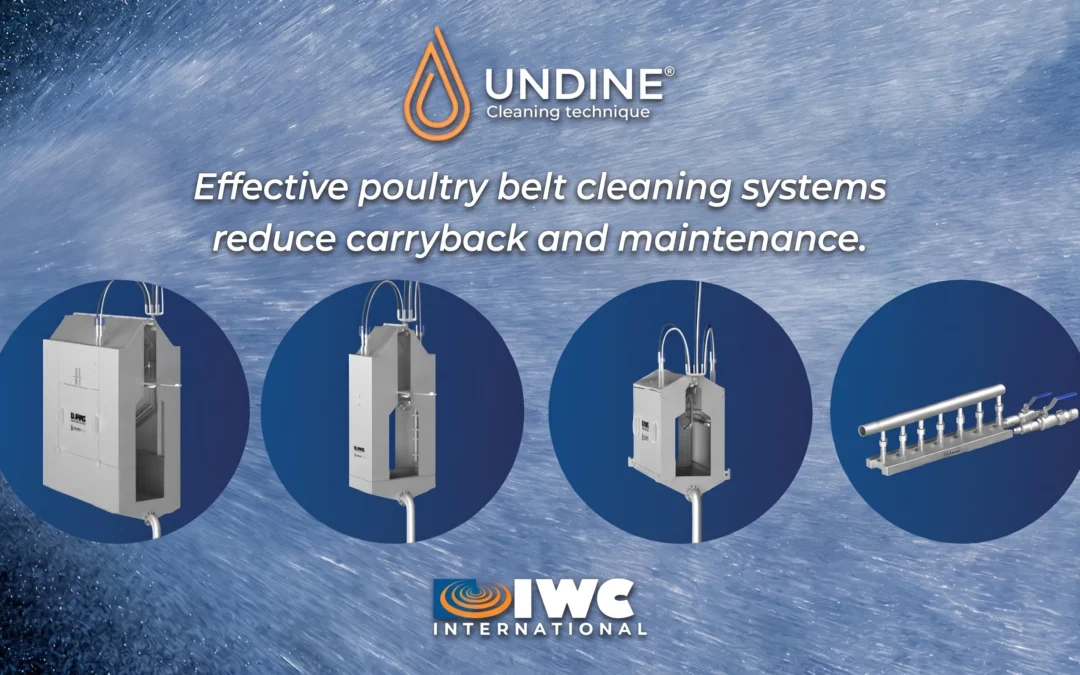
Belt cleaning systems on poultry lines need to stop residue from completing another circuit, not simply leave the exposed conveying surface looking cleaner. Fat, skin fragments and protein deposits can remain on the belt after discharge, travel onto the return run and reload rollers, supports or the next product-contact section.
A cleaner positioned at an accessible straight section may still miss the relevant contamination route. Residue can lodge at belt edges, move through modular joints or accumulate behind a scraper. Without effective collection, cleaning can also relocate soil onto the frame or into an adjacent product zone.
The specification should therefore connect three requirements: detach the residue, contain what is removed and prevent its return to product contact. That equipment-cleaning task must sit alongside product (carcass) cleaning at defined process hurdles, rather than substitute for it.
Position belt cleaning systems around the carryback route
Start at product discharge and trace the belt through one complete return circuit. Record where residue remains attached, where it transfers to another surface and where it can subsequently reach product. Distinguish material carried on the product-contact face from deposits on the underside, edges and drive components.
On modular belts, inspect joint openings and the geometry around sprockets. On continuous belts, examine splices, edge condition and surface damage. A worn surface or damaged joint may retain soil that a different nozzle position cannot resolve.
Locate the cleaning intervention where detached material can enter a controlled collection zone before contaminating additional components. This is not automatically the closest available mounting position. Access, belt presentation and drainage can make another location more suitable.
Assess the transfer itself as well. Product drop, carcass orientation and contact with guides can determine how much residue enters the return path. The requirements for an easy-clean conveyor at poultry carcass discharge help connect return-belt cleaning with the upstream transfer geometry.
Match the cleaning method to the residue and belt
For poultry applications, belt cleaning systems should be selected against the actual soil load and belt construction, not a generic conveyor-cleaner category. Mechanical removal, washing and thermal treatment perform different tasks and may need to work together.
| Method | Potential role | Main specification checks |
|---|---|---|
| Primary and secondary scrapers | Remove gross residue at discharge or further along the return | Belt and splice compatibility, blade loading, wear and residue collection |
| Brushes | Mechanically disturb accessible deposits | Filament suitability, access for sanitation and retained soil within the brush |
| Water spray bars | Detach and transport residue from exposed surfaces | Coverage, operating pressure, drainage and splash containment |
| Steam systems | Apply heat and moisture to suitable belt surfaces | Belt temperature limits, exposure, soil removal and condensate control |
| Air-assisted micro-droplet cleaning | Provide contact-free cleaning at a defined treatment position | Belt presentation, utility stability, coverage and collection |
A scraper can remove larger fragments without providing a complete sanitation process. Dry mechanical cleaning alone may leave adherent fatty or proteinaceous films. Brush contact introduces another component that must itself be cleaned and inspected.
Steam requires particular care with heat-sensitive belt materials and joints. Neither steam exposure nor a visually clean surface establishes an acceptable microbial result without verification. Likewise, conventional washdown needs a collection arrangement that prevents detached material from spreading beyond the cleaning zone.
Where Undine® fits
IWC International applies Undine® technology to conveyor belt spray bars as well as product washers, shackle and product-carrier washers and other poultry-processing applications. Undine® mixes water and compressed air into high-velocity micro-droplets of 5 to 25 µm that clean contact-free.
For belt cleaning systems, the practical question is whether that treatment reaches and removes the relevant deposits within the available exposure time. Contact-free application avoids relying on a blade or brush as the cleaning interface, but belt geometry still determines which surfaces are exposed.
An obstructed hinge recess does not become accessible simply because droplets are small. The specification must establish belt presentation, nozzle orientation and coverage of edges or joints where these are relevant. It must also provide a route for detached residue to leave the conveyor assembly.
Lower water, energy and labor requirements can follow from cleaning differently. They are application-dependent consequences, not substitutes for demonstrating cleaning performance under the site's production conditions.
Engineer containment before finalizing the spray position
A spray bar and its collection arrangement should be designed as one assembly. Check the trajectory of detached residue, splash from nearby surfaces and drainage under sustained production loading. Include the effects of belt motion and surrounding airflow.
Effective belt cleaning systems must prevent the cleaning zone from becoming a new contamination source. Enclosures, deflectors and collection trays should direct removed material away from exposed product, adjacent conveyors, bearings and electrical equipment. Their geometry must also permit inspection and sanitation.
Size drainage against the expected combination of process liquid and solids. A tray that drains clean water adequately may behave differently when skin fragments and fat enter it. Specify accessible solids removal and check that deposits cannot bridge an outlet or build up behind a deflector.
Inspect the return path downstream of the cleaner as well as the belt immediately after treatment. A clean belt followed by a contaminated roller can restore carryback within seconds. Define which neighboring components are included in the cleaning scope and which require separate attention during sanitation.
Establish the utility operating envelope
Record water pressure at the point of use while the cleaning system and relevant neighboring consumers are operating. A static pressure reading at a utility header does not show the conditions available during peak demand. Establish water quality and temperature requirements for the application.
Air-assisted belt cleaning systems also require a defined compressed-air supply. Confirm the required pressure, capacity and air quality with the supplier, including the site's specifications for air used near food-contact surfaces. Account for distribution losses and simultaneous demand elsewhere in the plant.
Agree the acceptable operating envelope before commissioning. Engineering and hygiene teams should define how deviations are detected, what action operators take and when production requires review. Do not assume that monitoring, alarms or interlocks are included unless they appear in the agreed scope.
Measure compressor energy as part of the operating assessment. Looking only at water or pump demand gives an incomplete picture of an air-assisted installation. Utility measurements should correspond to the settings at which cleaning performance has been demonstrated.
Make inspection and maintenance accessible
Cleaning equipment that cannot be inspected conveniently is difficult to keep reliable. Provide safe access to spray devices, scraper mounts, collection trays and drain connections without creating inaccessible spaces behind brackets or guards.
The maintenance plan for belt cleaning systems should distinguish cleaning-related deterioration from conveyor faults. Blade wear, nozzle obstruction, belt tracking changes and damaged joints require different corrective actions. Repeatedly adjusting the cleaner will not resolve a belt that runs outside its intended path.
For contact cleaners, follow the belt and cleaner suppliers' requirements for blade loading and adjustment. Excessive contact can damage a belt or splice; inadequate contact can leave untreated streaks. Record wear patterns rather than relying solely on a replacement date.
Set inspection intervals from loading, operating hours and observed deterioration, with additional checks after jams or belt damage. Perform physical inspection and adjustment under the site's isolation procedure. Define replacement parts, responsible personnel and access requirements before installation so maintenance does not depend on improvised access during production.
Keep carcass cleaning within the same hygiene plan
A cleaner return belt addresses one transfer mechanism. It does not remove contamination already present on a carcass, nor does it address every contact with shackles, carriers or guides. Product cleaning and equipment cleaning need separate objectives within a coordinated hurdle strategy.
When specifying belt cleaning systems, map the associated carcass route through discharge, transfer and subsequent handling. Identify where product cleaning is required and where cleaned product could encounter residue again. This prevents an equipment-only specification from leaving a product hygiene gap.
IWC's Undine® product washers provide contact-free carcass cleaning at defined hurdle positions. The appropriate position and configuration depend on the process step, carcass presentation, contamination challenge and surrounding equipment. A carcass washer should not be treated as interchangeable with a return-belt spray bar.
Evaluate shackle and product-carrier cleaning where these interfaces can transfer residue between stages. The hygiene plan should state what each hurdle controls, how its performance is checked and which downstream contacts could undermine that result. No individual intervention should be presented as eliminating food-safety risk.
Demonstrate control under representative production loading
Define acceptance criteria before assessing the installation. Include residual soil on relevant belt surfaces, carryback onto downstream components, containment performance and the condition of adjacent product-contact areas. Use microbial verification where required by the site's food-safety assessment.
Assess belt cleaning systems at representative line speed, product mix and residue loading, including conditions late in the production run. A short observation on a lightly loaded belt may not expose progressive buildup in trays, around joints or behind secondary components.
Compare equivalent operating conditions and sampling locations. Record production throughput, belt speed, product temperature where relevant, utility conditions and any manual intervention. If collecting carryback for measurement, use a safe, defined collection method and normalize results against a stated production quantity or operating period.
A Performance Validation should also distinguish residue removal from sanitation verification. Visual inspection, residue measurements and microbial results answer different questions. ATP measurements, where used, are hygiene indicators rather than direct pathogen measurements.
IWC's guidance on validating a belt cleaner on a poultry deboning line provides further detail on setting criteria and selecting representative assessment conditions. Document limitations as well as successful outcomes, particularly for inaccessible surfaces outside the treatment envelope.
Evaluate ownership cost against sustained cleaning performance
Build the ownership assessment around the configuration that meets the agreed hygiene criteria. Include equipment, mounting, guarding, utility connections, drainage modifications and installation downtime. A compact cleaning assembly can still require substantial work around an existing conveyor.
The operating cost of belt cleaning systems includes water, compressed-air electricity, any heating or pumping, inspection, sanitation labor, wear parts and waste handling. Record manual intervention during production separately from scheduled sanitation so recurring carryback removal remains visible.
Production continuity also matters. Establish the installation window, commissioning responsibilities and response to component failure. Confirm whether service access requires stopping only the conveyor or a wider connected process, and include that consequence in maintenance planning.
Any resource benefit should be calculated from measured demand and site-specific costs after cleaning performance is established. Do not transfer savings percentages from another application without accounting for residue load, belt geometry, utility conditions and the existing cleaning arrangement. The investment case is stronger when it connects reliable hygiene control with documented operating consequences.
FAQ's about poultry conveyor carryback control:
Do belt cleaning systems replace full conveyor sanitation? No. Inline residue removal can limit carryback during production, but it does not establish that joints, rollers, frames and other surfaces meet the site's sanitation criteria. Retain the established cleaning, disinfection and verification program.
How often should the return belt be cleaned? Where residue is continuously generated, an inline cleaning function may be appropriate during production. Its operating pattern and inspection frequency should follow the residue challenge and validated performance. Scheduled sanitation remains a separate requirement.
What should be checked for food-contact suitability? Confirm belt, cleaner and seal materials are suitable for their intended contact and operating conditions. Verify compatibility with approved chemicals, temperature and mechanical loading. Apply detergents and disinfectants according to supplier instructions, including concentration, contact time and rinsing requirements.
Can a return-belt cleaner replace carcass washing? No. Return-belt cleaning controls residue on equipment. Carcass washing addresses contamination on the product at a defined hurdle. Their locations and performance criteria should be coordinated, particularly where carcasses transfer onto belts or contact carriers.
Define the carryback problem before specifying hardware
Bring the belt route, residue observations, carcass transfer points and utility measurements into one engineering brief. Include containment, safe access, maintenance responsibilities and measurable acceptance criteria.
Discuss that brief with IWC International to establish where Undine® conveyor cleaning and product-cleaning hurdles fit the process. The required outcome is a controlled residue route: removal at the right location, contained discharge and protection against recontamination before the next product contact.